Durkheim is a theorist that has done research into how people within society manage to belong to and form a social structure which operates well without too much conflict. He claims that the social structure which is formed through people having shared norms and values is called a 'unifying force'. He suggests that institutions such as education and the media teach people to have what he calls a 'collective conscience', this is when people expect the same behaviour from each other because they have been taught that certain values and expectations are the 'norm'.
However it depends on different societies that people are a part of or surrounded by as to what norms and values are expected of them. Durkheim claims that a member of a collective conscience will have a shared understanding of its institutions,formal and informal rules, collective symbolism including values, ideals,opinions, mythologies and religions.
The extent to which someone is socially intergrated to a level similar to someone else or not can have an effect on their achievement within society. We could use this point to relate to our collective (young british) by claiming that certain values that are projected to them through institutions influence them to act a certain way.
Society is becoming increasingly individualistic with people's identities and actions throughout recent decades. Durkheim would claim this is a negative thing as he is a functionalist and believes that everything is set out because it performs a certain function and if things become too diverse people will start to loose their collective conscience. He suggests this means remedy is needed and an example of this is the encouragement of moral links with other members of society.
Showing posts with label Aggie Andrews. Show all posts
Thursday, 19 January 2012
Monday, 16 January 2012
Starting on our Media theory
We read into some media theorists beliefs and considered how their theories would help us in answering our prompt questions...
1. How does the media represent nations, regions and ethnic/social/collective groups of people in different ways?
2. How does contemporary representation compare to previous time periods?
3. What are the social implications of different media representations of groups of people?
4. To what extent is human identity increasingly mediated?
We came across a theorist called David Gauntlet, a professor of Media and Communications at the University of Westminster. His theories commonly express the idea of identity being a fluid concept "Not only is there more room for a greater variety of identities to emerge; it is also the case that the construction of identity has become a known requirement. Modern Western societies do not leave individuals in any doubt that they need to make choices of identity and lifestyle- even if their preferred options are rather obvious and conventional ones, or are limited due to the lack of financial (or cultural) resources" The part of David's concept which we can relate our research on collective identity to is the part where he discusses how the gender in the present day has changed and created new identities for people within society. For example he discusses how some social identities have changed such as the women's stereotypical identity in the early 1900's would have been viewed as a 'housewife' but he claims that this has now been improved to a more individual identity. Clearly he would argue this is a positive change within society , however we could argue that identity can be a 'fluid concept' because it is easily adaptable but our collective identity 'British teenagers' have had their stereotypical identity changed into a more negative light.
David Gauntlet is a good person we can use for research into media theory for our first question 'How does the media represent nations, regions and ethnic/social/collective groups of people in different ways?' because he discusses throughout his book ; Representations of gender in the past, Representations of gender today, Giddens (theorist) modernity and self-identity, Michel Foucault: lifestyle analyst, Queer theory and fluid identities, women's magazines and female identities today, and diections for living: Role models, pop music and self - help discourses. These are all generalised subjects about the identity of people within society and would provide us with a lot of information which relates to our questions asking us about the media and representations of different people.
1. How does the media represent nations, regions and ethnic/social/collective groups of people in different ways?
2. How does contemporary representation compare to previous time periods?
3. What are the social implications of different media representations of groups of people?
4. To what extent is human identity increasingly mediated?
We came across a theorist called David Gauntlet, a professor of Media and Communications at the University of Westminster. His theories commonly express the idea of identity being a fluid concept "Not only is there more room for a greater variety of identities to emerge; it is also the case that the construction of identity has become a known requirement. Modern Western societies do not leave individuals in any doubt that they need to make choices of identity and lifestyle- even if their preferred options are rather obvious and conventional ones, or are limited due to the lack of financial (or cultural) resources" The part of David's concept which we can relate our research on collective identity to is the part where he discusses how the gender in the present day has changed and created new identities for people within society. For example he discusses how some social identities have changed such as the women's stereotypical identity in the early 1900's would have been viewed as a 'housewife' but he claims that this has now been improved to a more individual identity. Clearly he would argue this is a positive change within society , however we could argue that identity can be a 'fluid concept' because it is easily adaptable but our collective identity 'British teenagers' have had their stereotypical identity changed into a more negative light.
David Gauntlet is a good person we can use for research into media theory for our first question 'How does the media represent nations, regions and ethnic/social/collective groups of people in different ways?' because he discusses throughout his book ; Representations of gender in the past, Representations of gender today, Giddens (theorist) modernity and self-identity, Michel Foucault: lifestyle analyst, Queer theory and fluid identities, women's magazines and female identities today, and diections for living: Role models, pop music and self - help discourses. These are all generalised subjects about the identity of people within society and would provide us with a lot of information which relates to our questions asking us about the media and representations of different people.
Thursday, 12 January 2012
Questions on our collective identity
The collective our example illustrates is the British youth. We will be representing male and female teenagers across Britain as this gives the our audience a balanced perspective of how both genders are portrayed to society. By using this collective we can find examples from the media and footage from television programs easily because we would be able to relate well to the issues relating to our collective that are being displayed.
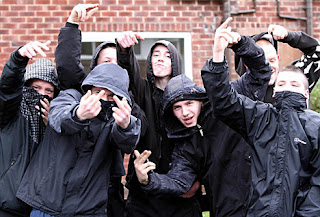
The representation of our collective group, British teenagers, has become a more negatively displayed representation throughout the media. We will be trying to demonstrate examples which clearly present this view, for example when the events of the riots were happening in cities of high population , the younger teens were the main focus of the newspapers. This was because it is more shocking to see teenagers of a younger age to be looting and committing non utilitarian crime and therefore makes a more interesting read for the newspaper's readers. This clearly is portraying teenagers in a negative light , and it demonstrates to the reader how society has this negative stereotype of teenagers in the present day because footage and recordings of a teenager helping an elderly lady over the road wouldn't be displayed on the front page of a popular newspaper. This suggests that we could argue the view of teenagers has changed over time possibly due to the way the media portrays our collective because the media influence a lot of the norms and values society excepts and learns from the papers.
Although the media can often display our collective negatively this can be an advantage for such institutions as the press and television because it can provide them with continuous interesting evidence or footage to use and adapt to display interesting messages and entertainment to what the audience or reader would be interested in. For instance the program Misfits sets up the entire setting of its series in a community service building for the characters. This indicates to the audience that the teenagers, our collective, have clearly done something wrong and deserve to be there, however it provides great entertainment for the audience at home as it is a unique setting but it does continue to display this negative stereotype of teenagers.
Another advantage of displaying the collective in this way is that from my perspective, the perspective of a young teenager, is that the negative judgement people within society can have of us can produce social change. For instance the government reconsiders the options to help get youths off of the streets , such as an increase in youth centers has dramatically risen in the last ten years.
A disadvantage of representing the collective in this way is that it can lead to people in society continuously having a negative stereotype of any individual teenager they meet. In addition to this negative displays of the collective within the media can lead to certain types of teenagers being specifically judged, for example if you are a certain race or are of a lower class they are more likely to be stigmatized by the public because they will be reflecting the stigma the media has attached to British teenagers.
The collective we are researching could be argued to having the most likely ability to convert the stigma that is attached to them by the media because they are the younger generation with a big future ahead of them. For instance many people would argue that young teenagers in Britain are offered an equal chance to gain high education and to establish themselves well within the economic society. People within society could also argue that young teenagers within Britain have many different clubs which they could attend to discover or build a talent within a sport etc. For instance Tom Bailey , the young diver from Plymouth, that aims to be held in the 2012 Olympics can display a good example of how young teenagers in Britain can produce an identity for themselves. However some people within society could claim that institutions such as education which are meant to provide the same equal opportunity for anyone, i.e. any class, any gender, any race etc don't always provide the right support for those who need it to gain the equal opportunity of success for their identity. For instance children from working class backgrounds may , without knowing, be labelled by teachers as low achievers within the school and therefore not be able to achieve similar success to middle class children. In addition to this these working class children may not be able to afford the necessary resources which would help them achieve their path to success through education. However the labour government did introduce facilities such as EMA to help those children who needed extra financial support with education resources to get it. Financial fundings for clubs and education etc are what a lot of people within our collective rely on to be able to reach or achieve their identity. However social change often means fundings which are provided by the government to help our collective are abolished , such as the decrease in payment for EMA since the coalition of the new government has happened.
The representation of our collective group, British teenagers, has become a more negatively displayed representation throughout the media. We will be trying to demonstrate examples which clearly present this view, for example when the events of the riots were happening in cities of high population , the younger teens were the main focus of the newspapers. This was because it is more shocking to see teenagers of a younger age to be looting and committing non utilitarian crime and therefore makes a more interesting read for the newspaper's readers. This clearly is portraying teenagers in a negative light , and it demonstrates to the reader how society has this negative stereotype of teenagers in the present day because footage and recordings of a teenager helping an elderly lady over the road wouldn't be displayed on the front page of a popular newspaper. This suggests that we could argue the view of teenagers has changed over time possibly due to the way the media portrays our collective because the media influence a lot of the norms and values society excepts and learns from the papers.
Although the media can often display our collective negatively this can be an advantage for such institutions as the press and television because it can provide them with continuous interesting evidence or footage to use and adapt to display interesting messages and entertainment to what the audience or reader would be interested in. For instance the program Misfits sets up the entire setting of its series in a community service building for the characters. This indicates to the audience that the teenagers, our collective, have clearly done something wrong and deserve to be there, however it provides great entertainment for the audience at home as it is a unique setting but it does continue to display this negative stereotype of teenagers.
Another advantage of displaying the collective in this way is that from my perspective, the perspective of a young teenager, is that the negative judgement people within society can have of us can produce social change. For instance the government reconsiders the options to help get youths off of the streets , such as an increase in youth centers has dramatically risen in the last ten years.
A disadvantage of representing the collective in this way is that it can lead to people in society continuously having a negative stereotype of any individual teenager they meet. In addition to this negative displays of the collective within the media can lead to certain types of teenagers being specifically judged, for example if you are a certain race or are of a lower class they are more likely to be stigmatized by the public because they will be reflecting the stigma the media has attached to British teenagers.
The collective we are researching could be argued to having the most likely ability to convert the stigma that is attached to them by the media because they are the younger generation with a big future ahead of them. For instance many people would argue that young teenagers in Britain are offered an equal chance to gain high education and to establish themselves well within the economic society. People within society could also argue that young teenagers within Britain have many different clubs which they could attend to discover or build a talent within a sport etc. For instance Tom Bailey , the young diver from Plymouth, that aims to be held in the 2012 Olympics can display a good example of how young teenagers in Britain can produce an identity for themselves. However some people within society could claim that institutions such as education which are meant to provide the same equal opportunity for anyone, i.e. any class, any gender, any race etc don't always provide the right support for those who need it to gain the equal opportunity of success for their identity. For instance children from working class backgrounds may , without knowing, be labelled by teachers as low achievers within the school and therefore not be able to achieve similar success to middle class children. In addition to this these working class children may not be able to afford the necessary resources which would help them achieve their path to success through education. However the labour government did introduce facilities such as EMA to help those children who needed extra financial support with education resources to get it. Financial fundings for clubs and education etc are what a lot of people within our collective rely on to be able to reach or achieve their identity. However social change often means fundings which are provided by the government to help our collective are abolished , such as the decrease in payment for EMA since the coalition of the new government has happened.
Monday, 9 January 2012
Economics and Culture, Media and community
http://www.shirky.com/writings/national_identity.html
I used this link to research into the cultural aspects that relate to, and influence the access to media. This article researched into how easily some nations have accessibility to the internet in comparison to less economically developed countries. For instance this article discusses how results have shown that the 'USA has 100 times more internet users than Arab states, and Europe has 70 times more users per capita than sub-Saharan Africa'. This is clearly a dramatic difference between the countries which the article claims the reasoning of dramatic economic difference is 'common knowledge'.
The united nations goes on to suggest that the clear contrast in internet access between these nations is bound to occur due to nations such as the USA and Europe being the ones who were first involved with creating the internet. They suggest that the use of internet within low economically developed countries will change not when the internet growth gradually increases but when there is economic and cultural change within their society's structure. Furthermore the message the United Nations seem to displaying to the reader is that these nations do not contribute as much as other nations to the media because they have greater issues to worry about , such as providing contraception and medicine for the majority of their population.Wealthy nations take their economy for granted and can therefore manipulate their easy access to the internet and not worry about issues other nations have to worry about.
The United Nations claim that countries which are ready for internet adoption need to through certain changes before it can be achieved. They suggest that political freedom is a big issue which needs to be accomplished in these low economically developed countries before people within society can feel free to use the internet without worrying, and to gain easier access to the internet without being restricted to their amount of usage. They also claim that the money resources in these countries need to be increased greatly in order to increase the telecommunication infrastructure. They are stating that money needs to be made in order for states such as the Arab and African states to be on the same telecommunication levels as American and European states.
The HDR report claim that increase in internet access in low Economically developed countries , or nations with high political control and Dictators are not going to achieve better internet access any time soon. The report claims that the United Nations are stupid for suggesting this increase because the last thing dictators would want people in society to have is a place such as online groups to stick together and create a feeling of unison. This would create a feeling of threat for dictators and highly controlled political groups as society within these suffering nations would gain a better collective identity and fight back for civil rights.
I used this link to research into the cultural aspects that relate to, and influence the access to media. This article researched into how easily some nations have accessibility to the internet in comparison to less economically developed countries. For instance this article discusses how results have shown that the 'USA has 100 times more internet users than Arab states, and Europe has 70 times more users per capita than sub-Saharan Africa'. This is clearly a dramatic difference between the countries which the article claims the reasoning of dramatic economic difference is 'common knowledge'.
The united nations goes on to suggest that the clear contrast in internet access between these nations is bound to occur due to nations such as the USA and Europe being the ones who were first involved with creating the internet. They suggest that the use of internet within low economically developed countries will change not when the internet growth gradually increases but when there is economic and cultural change within their society's structure. Furthermore the message the United Nations seem to displaying to the reader is that these nations do not contribute as much as other nations to the media because they have greater issues to worry about , such as providing contraception and medicine for the majority of their population.Wealthy nations take their economy for granted and can therefore manipulate their easy access to the internet and not worry about issues other nations have to worry about.
The United Nations claim that countries which are ready for internet adoption need to through certain changes before it can be achieved. They suggest that political freedom is a big issue which needs to be accomplished in these low economically developed countries before people within society can feel free to use the internet without worrying, and to gain easier access to the internet without being restricted to their amount of usage. They also claim that the money resources in these countries need to be increased greatly in order to increase the telecommunication infrastructure. They are stating that money needs to be made in order for states such as the Arab and African states to be on the same telecommunication levels as American and European states.
The HDR report claim that increase in internet access in low Economically developed countries , or nations with high political control and Dictators are not going to achieve better internet access any time soon. The report claims that the United Nations are stupid for suggesting this increase because the last thing dictators would want people in society to have is a place such as online groups to stick together and create a feeling of unison. This would create a feeling of threat for dictators and highly controlled political groups as society within these suffering nations would gain a better collective identity and fight back for civil rights.
Thursday, 5 January 2012
Question Four
To what extent is human identity increasingly mediated?
Human Identity is how people are portrayed by media institutions to the audience,readers or consumers that they are trying to sell to. The institutions we are researching in depth are television and the press. We have decided to revolve our research around the teenage population of society and how their collective identity is portrayed to society through institutions. The television industry have to continuously make sure the images of characters within series and TV dramas are appealing to the audience, fitting in with a certain theme relating to the show, or the present day fashion. In addition to this Documentaries are clearly based on real footage ,which in some ways makes the images displayed of teenagers in the program more interesting for the audience because they would see it as a reflection of their true human identity. However producers of Documentaries can manipulate the audience by only choosing negative footage of teenagers to display. We have chosen to research how the media portrays stereotypical images of a teenager in the present day to its audience and society.
The Tv series we have chosen to research so far are Skins and Misfits. This is because we automatically thought of these programs as featuring characters that are reflecting living in as their teenage years. Also it is clear to the audience when watching these shows how distinct the representation of the negative stereotype that is increasingly attached to the teenagers human identity in todays society. We will be researching how these stereotype images are displayed,through what features and costume etc, and how they maintain the images throughout every episode of the series. our group will also do heavy research into why skins and Misfits are featured on channel four at a later time of the night , because clearly this plays a big part on the audience's thoughts about what is featured in the program, and whether the events etc are negative for an audience (especially children) to be viewing.
The press industry also creates a stereotypical human identity for teenagers of the present day. We will be using ideas such as the riots from 2011 for our case study. We will be looking at how the newspapers have chosen certain images they wanted to display to the reader, and the type of language they use to manipulate the reader to how they receive the information. We will compare how newspapers have written more about the negative impact and presence of teenagers within society today, in comparison to the way teenagers were portrayed through newspapers in the past . We may discover that their has been a dramatic increase as to the amount of information written about teenagers in newspapers today in contrast to how little was displayed about them , for example , in the 1900's. We will have to research and then conclude why we think these images are increasingly mediated in the press.
We will research how different newspapers are biased and aim their featured information at different targeted readers. We will research this because it is interesting to find out which newspapers are more likely to produce a negative human identity of teenagers and which are more likely to produce a more positive image of teenage human identity.
Human Identity is how people are portrayed by media institutions to the audience,readers or consumers that they are trying to sell to. The institutions we are researching in depth are television and the press. We have decided to revolve our research around the teenage population of society and how their collective identity is portrayed to society through institutions. The television industry have to continuously make sure the images of characters within series and TV dramas are appealing to the audience, fitting in with a certain theme relating to the show, or the present day fashion. In addition to this Documentaries are clearly based on real footage ,which in some ways makes the images displayed of teenagers in the program more interesting for the audience because they would see it as a reflection of their true human identity. However producers of Documentaries can manipulate the audience by only choosing negative footage of teenagers to display. We have chosen to research how the media portrays stereotypical images of a teenager in the present day to its audience and society.
The Tv series we have chosen to research so far are Skins and Misfits. This is because we automatically thought of these programs as featuring characters that are reflecting living in as their teenage years. Also it is clear to the audience when watching these shows how distinct the representation of the negative stereotype that is increasingly attached to the teenagers human identity in todays society. We will be researching how these stereotype images are displayed,through what features and costume etc, and how they maintain the images throughout every episode of the series. our group will also do heavy research into why skins and Misfits are featured on channel four at a later time of the night , because clearly this plays a big part on the audience's thoughts about what is featured in the program, and whether the events etc are negative for an audience (especially children) to be viewing.
The press industry also creates a stereotypical human identity for teenagers of the present day. We will be using ideas such as the riots from 2011 for our case study. We will be looking at how the newspapers have chosen certain images they wanted to display to the reader, and the type of language they use to manipulate the reader to how they receive the information. We will compare how newspapers have written more about the negative impact and presence of teenagers within society today, in comparison to the way teenagers were portrayed through newspapers in the past . We may discover that their has been a dramatic increase as to the amount of information written about teenagers in newspapers today in contrast to how little was displayed about them , for example , in the 1900's. We will have to research and then conclude why we think these images are increasingly mediated in the press.
We will research how different newspapers are biased and aim their featured information at different targeted readers. We will research this because it is interesting to find out which newspapers are more likely to produce a negative human identity of teenagers and which are more likely to produce a more positive image of teenage human identity.
Subscribe to:
Posts (Atom)